

2.1.1 Sequencing, Selection, and Repetition
Think about how you actually get ready for school. You do not follow the exact same list every day. If it is raining, you grab an umbrella; if it is not, you leave it. You brush your teeth until they feel clean, however long that takes. Your routine reacts to the situation.
Every algorithm you have seen so far could not do that. In Topic 1.1, an algorithm was a list of steps done one at a time, in order: sequencing. Every Java program in Unit 1 worked the same way: each statement ran exactly once, from top to bottom, no matter what. A pure sequence has no way to say “only sometimes” or “keep going until.”
Real algorithms need two more kinds of steps. Together with sequencing, they are the three building blocks of algorithms, the only pieces you need to describe any algorithm:
- Sequencing: steps are done one after another, in order.
- Selection: the algorithm makes a decision and chooses which step to do next. “If it is raining, take an umbrella” is selection. Another name for it is decision making.
- Repetition: a step, or a group of steps, is done again and again until a goal is reached. “Brush until your teeth are clean” is repetition. Another name for it is looping, and the repeated steps are called a loop.
Key idea
Algorithms are built from three building blocks: sequencing (steps in order), selection (choosing what to do next with a decision), and repetition (repeating steps with a loop until a goal is reached).
Worked example: Finding the building blocks in a routine
Here is a morning routine written as numbered steps:
- Get dressed.
- If it is raining, take an umbrella.
- Brush your teeth until they are clean.
- Walk to school.
Go through it step by step and ask what kind of step each one is:
| Step | Building block | How you can tell |
|---|---|---|
| 1. Get dressed. | Sequencing | Always done, once, in its place in the order |
| 2. If it is raining, … | Selection | Whether the umbrella step happens depends on a decision |
| 3. Brush … until clean. | Repetition | Brushing continues again and again until a goal (“clean”) is reached |
| 4. Walk to school. | Sequencing | Always done, once, after step 3 |
Notice that the whole list is still a sequence: step 2 comes after step 1, and step 3 comes after step 2. Selection and repetition live inside that order. Sequencing is the backbone that holds the other two in place.
Now change one thing: the day. On a sunny day, the umbrella step is skipped, so the routine does steps 1, 3, and 4. On a day when brushing takes longer, step 3 simply repeats more times. The written algorithm is the same on every day, but what actually happens changes with the situation. A pure sequence could never do that; it always does the same steps the same number of times.
Watch out
“Writing a step several times is repetition.” A student writes a recipe like this:
- Stir the batter.
- Stir the batter.
- Stir the batter.
That is still pure sequencing: three separate steps, each done once. It also guesses that three stirs is right. Real repetition is a single instruction to repeat until a goal is reached, such as “Stir the batter until there are no lumps.” That version works whether the batter needs two stirs or twenty, because the goal decides when to stop, not a guess.
Pause and try
Question 1 · Multiple choice
A set of directions for a board game includes the step “If you roll a 6, take another turn.” Which building block does this step show?
- Sequencing, because it is one of the steps in the directions
- Selection, because whether you take another turn depends on a decision
- Repetition, because rolling dice happens many times in the game
- None, because a game rule is not an algorithm
Check your reasoning
B. The step asks a question (“Did you roll a 6?”) and the answer chooses what happens next. That is selection, also called decision making.
- A is wrong: every step is part of the order, but this step does something extra. It does not always happen; a decision controls it.
- C is wrong: repetition means a step repeats until a goal is reached. This step happens once per roll and only when the decision says so.
- D is wrong: game directions are steps that get a job done (playing the game), so they are an algorithm.
Reread 2.1.1 Sequencing, Selection, and Repetition if you chose differently.
Question 2 · Short answer
Here are directions for washing dishes: (1) Fill the sink with warm water. (2) Wash a dish. (3) Repeat step 2 until no dirty dishes are left. (4) If the water is still clean, leave it for later; otherwise, drain the sink. Name the building block shown by step 1, by step 3, and by step 4, and give a reason for each.
Check your reasoning
Model answer: Step 1 is sequencing: it is always done, once, in its place in the order. Step 3 is repetition: step 2 is done again and again until a goal is reached (no dirty dishes left). Step 4 is selection: a decision about the water chooses between two actions.
A complete answer must:
- match all three steps to the right building block, and
- give a reason for each: always done once (sequencing), a decision chooses what happens (selection), steps repeat until a goal is reached (repetition).
Reread 2.1.1 Sequencing, Selection, and Repetition if any match was different.
2.1.2 Selection: Deciding with a True-or-False Question
Selection lets an algorithm handle different situations. But think back to Topic 1.1: a computer is a literal follower. It cannot weigh options or use judgment. So how can it “decide” anything?
The trick is to make every decision a question with exactly two possible answers: true or false. “Is it raining?” is either true or false. A literal follower can check it and then do what the algorithm says to do for that answer. Selection happens when the choice of how an algorithm continues is based on a true-or-false decision. The question being checked is called the condition.
In written language, selection usually looks like one of these two shapes:
- Do something, or skip it: “If condition, then do this step.” When the condition is false, the step is skipped and the algorithm moves on.
- Choose between two steps: “If condition, then do this step; otherwise, do that step.” Exactly one of the two steps happens.
Either way, after the decision is made, the algorithm continues with the next step in the sequence.
Key idea
Selection chooses how an algorithm continues based on a condition: a question whose answer is either true or false.
Worked example: A movie ticket price
A theater uses this algorithm to find a ticket price:
- Ask for the customer’s age.
- If the age is less than 13, the price is $8; otherwise, the price is $12.
- Print the ticket.
The condition is “the age is less than 13.” To trace a decision, try it with different inputs and follow the path each one takes:
| Age | Is the age less than 13? | Step chosen | Price |
|---|---|---|---|
| 9 | true | “the price is $8” | $8 |
| 15 | false | “the price is $12” | $12 |
| 13 | false (13 is not less than 13) | “the price is $12” | $12 |
The row for age 13 matters most. The number 13 sits right on the edge between the two choices, so it is the input most likely to be handled wrong. “Less than 13” is false for 13, so a 13-year-old pays $12. If the theater wanted 13-year-olds to pay $8, the condition would have to be “the age is 13 or less.” When you check a decision, always test a value right at the edge.
Now a decision you have already used without seeing it. Math.abs from Topic 1.11 returns a number’s absolute value: its distance from zero. You can describe the result it produces as an algorithm with a decision:
- If the number is less than 0, the answer is the number with its sign flipped; otherwise, the answer is the number itself.
Test that description against the real method:
System.out.println(Math.abs(-7));
System.out.println(Math.abs(4));
System.out.println(Math.abs(0));7
4
0| Number | Is the number less than 0? | Answer |
|---|---|---|
| -7 | true | flip it: 7 |
| 4 | false | keep it: 4 |
| 0 | false (0 is not less than 0) | keep it: 0 |
All three outputs match the written algorithm. We are not looking inside Math.abs here, only describing what it produces. The point is that a method you called in Unit 1 behaves like an algorithm with selection: its result depends on a true-or-false decision about its input.
Watch out
A “decision” that is not a true-or-false question. A student writes: “Decide what to wear based on the weather.” A literal follower cannot carry this out. “The weather” is not true or false; it could be sunny, cloudy, snowy, or windy, and the step never says what to do for any of them.
Fix it by rewriting the decision as a question with only two answers and saying what to do for each: “If the temperature is below 50 degrees, wear a jacket; otherwise, wear a T-shirt.” Now the follower checks one true-or-false condition and knows exactly which step to take.
Pause and try
Question 3 · Tracing
An online store uses this algorithm:
- Add up the prices of the items in the cart.
- If the total is at least $35, shipping is free; otherwise, shipping costs $6.
- Display the total plus shipping.
What amount is displayed for a cart totaling $20, and for a cart totaling $35?
Check your reasoning
| Cart total | Is the total at least $35? | Shipping | Displayed |
|---|---|---|---|
| $20 | false | $6 | $26 |
| $35 | true ($35 counts as “at least $35”) | free | $35 |
The $35 cart is the edge value. “At least $35” means $35 or more, so the condition is true and shipping is free. If you got $41 for that cart, you treated “at least” as “more than.”
Reread 2.1.2 Selection: Deciding with a True-or-False Question if your answer differed.
Question 4 · Multiple choice
Which step is written so that a literal follower can make the decision?
- “If the soup is ready, serve it.”
- “If the soup has been simmering for at least 20 minutes, serve it.”
- “Serve the soup when it seems right.”
- “Choose how to serve the soup.”
Check your reasoning
B. The condition “the soup has been simmering for at least 20 minutes” is clearly true or false at any moment, so a literal follower can check it.
- A is wrong: “ready” is a judgment. A literal follower has no way to tell whether it is true.
- C is wrong: “seems right” is also a judgment, not a true-or-false question anyone can check the same way.
- D is wrong: it asks the follower to choose but gives no condition and no choices.
Reread 2.1.2 Selection: Deciding with a True-or-False Question if you chose differently.
2.1.3 Repetition: Repeating Until the Goal Is Reached
Suppose you are saving up for $50 headphones, and you put $15 from your paycheck into savings each week. How many weeks will it take? You could work it out first and write that many steps. But if the price or the paycheck changes, the steps are wrong. In Unit 1, the only way to do something several times in Java was to write the statement several times, just like the “stir, stir, stir” recipe from 2.1.1.
Repetition means doing the same steps over and over until you get the result you were aiming for. Instead of guessing how many times, the algorithm states the goal and checks it: “Add $15 to savings until savings is at least $50.” The steps that repeat form a loop. Each time through the loop, the follower does the repeated steps and then checks whether the goal has been reached. If not, it goes around again. If so, the loop ends and the algorithm moves on to the next step.
Look closely at that check: “Is savings at least $50?” It is a true-or-false question, just like the condition in a selection. Every loop contains a decision about whether to keep going.
Key idea
Repetition repeats a process until a desired outcome is reached. A true-or-false check of that outcome decides whether the loop goes around again or stops.
Worked example: Saving for headphones
- Set savings to $0.
- Repeat: add $15 to savings, until savings is at least $50.
- Buy the headphones.
Trace the loop one pass at a time. A pass here means one time through the repeated step, followed by the check:
| Pass | Savings after adding $15 | Is savings at least $50? | What happens next |
|---|---|---|---|
| 1 | $15 | false | Go around again |
| 2 | $30 | false | Go around again |
| 3 | $45 | false | Go around again |
| 4 | $60 | true | Stop; go to step 3 |
The loop runs 4 times, and savings ends at $60. Notice that the algorithm never said “four.” The number of passes came from the goal.
Now vary the starting point. Suppose you already have $20 when you begin, so step 1 says “Set savings to $20.” The first pass brings savings to $35 (false), and the second brings it to $50 (true; $50 is at least $50). The loop stops after only 2 passes. Same loop, same goal, different situation, different number of passes. That is exactly what repetition is for.
Sometimes the goal is a count. “Do 10 jumping jacks” can be written as a loop that keeps track of how many are done: (1) Set count to 0. (2) Repeat: do a jumping jack, then add 1 to count, until count is 10. The goal “count is 10” is reached after exactly 10 passes.
Watch out
A loop that never reaches its goal. Look at this algorithm:
1. Set savings to $0.
2. Repeat: spend $5 from savings, until savings is at least $50.
Each pass makes savings smaller: -$5, -$10, -$15, and so on. Savings can never reach $50, so the check is false every single time. A literal follower would keep going forever. This is called a never-ending loop (programmers also say infinite loop).
Students write never-ending loops when they focus on the goal and forget to check that each pass actually moves toward it. To fix one, make sure the repeated steps change things in the direction of the goal: “add $15,” not “spend $5.”
Pause and try
Question 5 · Tracing
A baker has 23 cookies and follows this algorithm:
- Repeat: put 6 cookies into a new bag, until fewer than 6 cookies are left.
- Eat the cookies that are left.
How many bags are filled, and how many cookies does the baker eat? Show a trace table.
Check your reasoning
| Pass | Cookies left after filling a bag | Are fewer than 6 left? |
|---|---|---|
| 1 | 17 | false |
| 2 | 11 | false |
| 3 | 5 | true |
The loop stops after the third pass, so 3 bags are filled, and the baker eats the 5 cookies that are left. If you got 4 bags, you kept going after the goal was reached; the check comes after each pass, and it was true after pass 3.
Reread 2.1.3 Repetition: Repeating Until the Goal Is Reached if your answer differed.
Question 6 · Multiple choice
Which algorithm is a never-ending loop?
- Set the water level to 0 cm. Repeat: add 2 cm of water, until the water level is at least 10 cm.
- Set the temperature to 80 degrees. Repeat: lower the temperature by 3 degrees, until the temperature is below 70 degrees.
- Set the count to 0. Repeat: clap once, then add 1 to the count, until the count is 5.
- Set the gas in the tank to 10 gallons. Repeat: drive 30 miles, which uses 1 gallon, until the tank holds at least 12 gallons.
Check your reasoning
D. The gas starts at 10 gallons and each pass makes it smaller (9, 8, 7, …). Driving moves away from the goal of “at least 12 gallons,” so the check is never true and the loop never ends. (A real car would run out of gas, but the algorithm itself never says to stop.)
- A is wrong: the level goes 2, 4, 6, 8, 10, and stops after 5 passes.
- B is wrong: the temperature goes 77, 74, 71, 68, and stops after 4 passes because 68 is below 70.
- C is wrong: the count goes 1, 2, 3, 4, 5, and stops after 5 passes.
Reread 2.1.3 Repetition: Repeating Until the Goal Is Reached if you chose differently.
2.1.4 Showing Decisions and Loops in Words and Diagrams
In Topic 1.1 you represented algorithms in two ways: as numbered written steps and as a flowchart, where each step is a box and the arrows show the order. Those flowcharts were straight lines: one arrow in, one arrow out, from Start to Stop. A decision breaks that pattern, because after it the algorithm can go two different ways. How do you show that?
In a flowchart, a decision is drawn as a diamond, called a decision diamond. The condition is written inside it, and two arrows leave it: one labeled true and one labeled false. In the diagrams below, the diamond is drawn with pointed ends like < this >, regular steps are in square brackets, and Start and Stop are in parentheses. Here is the umbrella step from 2.1.1:
         ( Start )
             |
             v
    < Is it raining? >
      |            |
     true        false
      |            |
      v            |
 [Take umbrella]   |
      |            |
      v            v
     [Walk to school]
             |
             v
         ( Stop )
Follow it on a rainy day: the condition is true, so take the left arrow to “Take umbrella,” then continue to “Walk to school.” On a dry day, take the false arrow, which goes straight to “Walk to school,” skipping the umbrella. Both paths come back together, because after the decision the algorithm continues in sequence.
A loop is shown with an arrow that points back up to an earlier step. The decision diamond checks the goal: one arrow leaves the loop, and the other goes back around. Here is the savings algorithm from 2.1.3:
        ( Start )
            |
            v
   [Set savings to $0]
            |
            v
        [Add $15] <------+
            |            |
            v            | false
 < Savings at least $50? >
            |
            | true
            v
        ( Stop )
The false arrow leaves the right side of the diamond and climbs back to “Add $15.” That backward arrow is the repetition. When the condition is finally true, the downward arrow leads out of the loop.
In written language, you have already seen “If …, then …; otherwise, …” and “Repeat … until ….” A third way, which matches a flowchart arrow for arrow, writes the backward arrow as a “go back” instruction:
- Set savings to $0.
- Add $15 to savings.
- If savings is less than $50, go back to step 2.
- Stop.
Key idea
In a flowchart, a decision is a diamond with a true arrow and a false arrow, and a loop is an arrow that goes back to an earlier step. In written steps, the same ideas are “if … otherwise …,” “repeat … until …,” or “go back to step ….”
Worked example: Checking that two representations match
Compare the written version to the diagram, one piece at a time:
| Written step | Flowchart piece |
|---|---|
| 1. Set savings to $0. | First box after Start |
| 2. Add $15 to savings. | The box the backward arrow points to |
| 3. If savings is less than $50, go back to 2. | The diamond; its false arrow goes back to “Add $15” |
| 4. Stop. | The true arrow out of the diamond leads to Stop |
Notice that step 3 asks “less than $50?” while the diamond asks “at least $50?” They are opposite questions, so the arrows are swapped too: written step 3 goes back when its answer is true, and the diamond goes back when its answer is false. Both send the follower back in exactly the same situations (whenever savings is under $50), so they represent the same algorithm. When you compare two representations, check which answer leads where, not just whether the words look alike.
Watch out
A backward arrow that points to the wrong step. Suppose the false arrow from the diamond went back to “Set savings to $0” instead of “Add $15.” Then every pass would reset savings to $0 and add $15, so savings would be $15 at every check. The goal is never reached, and the loop never ends.
Students make this mistake because the arrow looks like it goes “back to the start of the loop.” Ask yourself which steps should repeat. Setting savings to $0 should happen once, before the loop, so the backward arrow must point to the first step that repeats, “Add $15.”
Pause and try
Question 7 · Tracing
Trace this algorithm and give the final value of total and the number of times step 2 is done.
- Set total to 1.
- Double total.
- If total is less than 20, go back to step 2.
- Stop.
Check your reasoning
| Time step 2 is done | Total after doubling | Is total less than 20? | Next |
|---|---|---|---|
| 1 | 2 | true | step 2 |
| 2 | 4 | true | step 2 |
| 3 | 8 | true | step 2 |
| 4 | 16 | true | step 2 |
| 5 | 32 | false | step 4 |
Step 2 is done 5 times, and total ends at 32. Step 1 is done only once, because step 3 sends the follower back to step 2, not step 1. A common mistake is stopping at 16 because “16 is close to 20”; the check only cares whether the condition is true, and 16 is still less than 20.
Reread 2.1.4 Showing Decisions and Loops in Words and Diagrams if your answer differed.
Question 8 · Multiple choice
In this flowchart, the diamond’s false arrow goes back up to “Take one step forward.”
         ( Start )
             |
             v
 [Take one step forward] <---+
             |               |
             v               | false
   < Are you at the door? >--+
             |
             | true
             v
      [Open the door]
             |
             v
         ( Stop )
Which written algorithm represents the same algorithm?
- Take one step forward. If you are at the door, open the door. Stop.
- Repeat: take one step forward, until you are at the door. Then open the door.
- Repeat: open the door, until you are at the door. Then take one step forward.
- If you are not at the door, open the door; otherwise, take one step forward.
Check your reasoning
B. The backward false arrow makes “Take one step forward” repeat until the condition “Are you at the door?” is true. Then the true arrow leads out of the loop to “Open the door.”
- A is wrong: it has a decision but no backward arrow, so it takes only one step. If the door is farther away, the door is never opened.
- C is wrong: it repeats the wrong step. In the diagram, the backward arrow points to “Take one step forward,” so that is the step inside the loop.
- D is wrong: it has no loop at all, and it swaps the actions: the diagram opens the door only when you are at the door.
Reread 2.1.4 Showing Decisions and Loops in Words and Diagrams if you chose differently.
2.1.5 Order Matters When You Combine Them
Back in Topic 1.1, you saw that the same steps in a different order can give a different result: socks before shoes, not after. That was about sequencing alone. Now an algorithm can have decisions and loops too, and the question becomes: does it matter where they go?
It does. Where you place each step, each decision, and each loop helps decide what the algorithm produces. A decision checks the situation at the moment it is made, so a step placed before the decision can change the answer. A loop’s check can come before or after the repeated steps, and that changes how many times they run.
Key idea
The order of sequencing, selection, and repetition affects the outcome. The same steps and decisions, arranged differently, can produce a different result.
Worked example: A coupon before or after shipping
A store has a coupon: $10 off any order of at least $30. Shipping costs $5. Here are two algorithms with the same steps in a different order:
Algorithm A
- Add $5 shipping to the total.
- If the total is at least $30, take $10 off.
Algorithm B
- If the total is at least $30, take $10 off.
- Add $5 shipping to the total.
Trace both for an order of $27:
| Algorithm | After step 1 | Is the total at least $30? | Final total |
|---|---|---|---|
| A | $27 + $5 = $32 | true ($32): take $10 off | $22 |
| B | not yet checked: $27 | false ($27): no coupon | $32 |
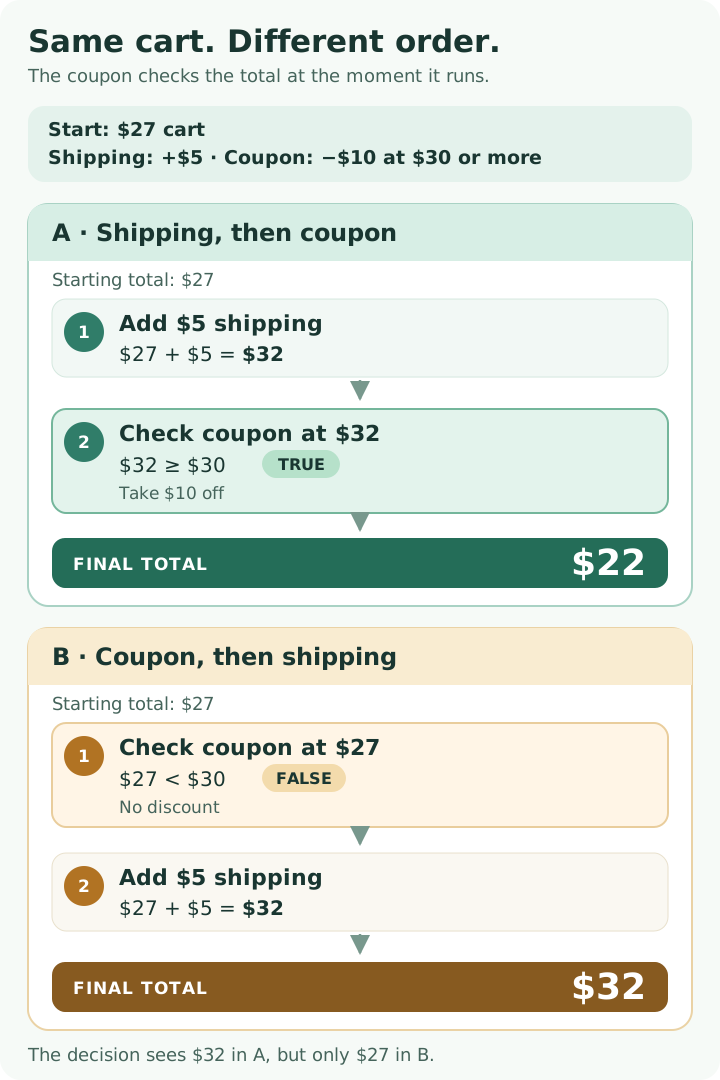
For Algorithm B, the decision happens first, while the total is still $27. Then shipping is added: $27 + $5 = $32. Algorithm A adds shipping first, so the total has grown to $32 by the time the decision checks it. The same $27 order costs $22 in one algorithm and $32 in the other. The steps are identical; only the order changed, and with it the moment the decision looked at the total.
Now vary the building block: move a loop’s check. Compare two ways to water a plant:
- Check after: Repeat: pour a cup of water, until the soil is wet.
- Check first: Check whether the soil is wet; if it is not, pour a cup of water and check again.
When the soil starts out dry, both pour until it is wet. But suppose it rained last night and the soil is already wet. The check-after version pours a cup anyway, because it does the repeated step before it ever checks. The check-first version pours zero cups. Placing the check before or after the repeated step changes the outcome in exactly this kind of edge case.
Order matters in Java too. Even in Unit 1 programs, which only use sequencing, swapping two statements can change the result. These two snippets use the compound assignment operators from Topic 1.6 on the same starting value:
int points = 10;
points += 5;
points *= 2;
System.out.println("Points: " + points);Points: 30int points = 10;
points *= 2;
points += 5;
System.out.println("Points: " + points);Points: 25In the first snippet, points goes 10 → 15 → 30: the bonus of 5 is added and then doubled along with everything else. In the second, points goes 10 → 20 → 25: the bonus is added after doubling, so it counts only once. Neither is wrong; they are different algorithms, and the order you choose must match what you want to happen.
Watch out
“Same steps, same result.” Students check that an algorithm has all the right steps and the right decisions and stop there. As the coupon example shows, that is not enough. A decision only sees the situation at the moment it runs, so you must also ask, “What has already happened by the time this check is made?” When an algorithm gives a wrong result, try tracing it with a value near the edge (like $27 or $30 for the coupon) and watch what each decision sees.
Pause and try
Question 9 · Tracing
A game starts a player with 40 points and uses this algorithm at the end of a level:
- If the player has at least 50 points, award a gold star.
- Add 15 bonus points.
Does the player get a gold star? Would the answer change if steps 1 and 2 were swapped? Show what the decision sees in each order.
Check your reasoning
| Order | Points when the decision is checked | At least 50? | Gold star? | Final points |
|---|---|---|---|---|
| As written | 40 | false | No | 55 |
| Steps swapped | 40 + 15 = 55 | true | Yes | 55 |
Both orders end with 55 points, but only the swapped order awards the star, because only in that order has the bonus already been added when the decision looks at the points. Same steps, different order, different outcome.
Reread 2.1.5 Order Matters When You Combine Them if your answer differed.
Question 10 · Debugging
A game’s rules say: “At the end, double the player’s score, and then add a 50-point bonus.” A player finishes with 100 points, so the final score should be 250. This code prints Final score: 300. Find the error and write the corrected code.
int score = 100;
score += 50;
score *= 2;
System.out.println("Final score: " + score);Check your reasoning
The two compound assignments are in the wrong order. The code adds the bonus first (100 → 150) and then doubles it (150 → 300), so the bonus gets doubled too. This is a logic error from Topic 1.1: the program compiles and runs, but the result is wrong.
The fix swaps lines 2 and 3 so the order matches the rules:
int score = 100;
score *= 2;
score += 50;
System.out.println("Final score: " + score);
Now score goes 100 → 200 → 250, and the program prints Final score: 250.
Reread 2.1.5 Order Matters When You Combine Them if you did not spot the order problem.
Putting it together
Real algorithms usually combine all three building blocks, often with a decision inside a loop. Here is one you already know the result of: finding where a letter first appears in a word, which is what indexOf from Topic 1.15 reports.
To find the first "p" in "hopper":
- Set position to 0.
- Repeat these steps until the search is done:
- If position is past the last letter, the answer is -1 and the search is done.
- Otherwise, if the letter at position is
"p", the answer is position and the search is done. - Otherwise, add 1 to position.
The building blocks: step 1 then step 2 is sequencing; step 2 is repetition; and each pass makes decisions (first “is position past the end?”, then “is this letter a p?”). Recall that the letters of "hopper" sit at indices 0 through 5:
index:  0 1 2 3 4 5
letter: h o p p e r
Trace it:
| Pass | Position | Past the last letter? | Letter is “p”? |
|---|---|---|---|
| 1 | 0 | false | false (“h”): add 1 |
| 2 | 1 | false | false (“o”): add 1 |
| 3 | 2 | false | true: answer is 2, done |
The search stops at position 2, the first "p", and never looks at the second "p" at index 3. Searching for "z" would find no match at positions 0 through 5; then position becomes 6, which is past the last letter, so the answer is -1.
Order matters here as well. The “past the last letter?” decision comes first in each pass for a reason: if the algorithm tried to look at the letter at position 6 first, there would be no letter there to look at. In Java, asking for a character that does not exist causes a run-time error, as you saw with substring in Topic 1.15.
Now check the written algorithm against Java:
String word = "hopper";
System.out.println(word.indexOf("p"));
System.out.println(word.indexOf("z"));2
-1Both results match the trace. We are not claiming this is exactly how Java’s indexOf is written inside; the point is that its behavior is described by an algorithm that uses sequencing, selection, and repetition together. Later in this unit, you will learn the Java statements that let you write decisions and loops like these yourself.
Vocabulary
| Term | Definition | Example |
|---|---|---|
| building blocks | The three kinds of steps every algorithm is built from: sequencing, selection, and repetition | A routine with ordered steps, a decision, and a loop |
| sequencing | Doing steps one at a time, in order | Get dressed, then walk to school |
| selection / decision making | Choosing how an algorithm continues based on a true-or-false decision | If it is raining, take an umbrella |
| condition | The true-or-false question a decision checks | “Is the age less than 13?” |
| repetition / looping | Repeating a process until a desired outcome is reached | Add $15 until savings is at least $50 |
| loop | The steps that repeat | “Add $15 to savings” |
| pass | One time through a loop’s repeated steps, followed by the check | Pass 3 brings savings to $45 |
| never-ending loop / infinite loop | A loop whose goal is never reached, so it never stops | Spend $5 until savings is at least $50 |
| decision diamond | The flowchart shape for a decision, with a true arrow and a false arrow | < Is it raining? > |
Chapter summary
- Every algorithm is built from three building blocks: sequencing (steps in order), selection (decision making), and repetition (looping).
- Selection chooses how an algorithm continues based on a condition, a question that is either true or false. Test decisions with a value right at the edge.
- Repetition repeats a process until a desired outcome is reached; a true-or-false check after each pass decides whether to go around again. If the repeated steps never move toward the goal, the loop never ends.
- Decisions and loops can be written in words (“if … otherwise …,” “repeat … until …,” “go back to step …”) or drawn in a flowchart with decision diamonds and backward arrows.
- The order of sequencing, selection, and repetition affects the outcome, because a decision only sees what has happened before it is checked.
Review questions
Question 11 · Tracing
A teacher flips through a stack of quiz cards with the scores 82, 64, 91, and 70, in that order, using this algorithm:
- Set passCount to 0.
- Repeat until no cards are left: take the top card; if its score is at least 70, add 1 to passCount.
- Announce passCount.
What number is announced? Show a trace table.
Check your reasoning
| Pass | Score on card | At least 70? | passCount after the pass |
|---|---|---|---|
| 1 | 82 | true | 1 |
| 2 | 64 | false | 1 |
| 3 | 91 | true | 2 |
| 4 | 70 | true | 3 |
After pass 4, no cards are left, so the loop ends and 3 is announced. The last card is the edge value: 70 is “at least 70,” so it counts. The decision is inside the loop, so it is made once per card.
Reread 2.1.3 Repetition: Repeating Until the Goal Is Reached and 2.1.2 Selection: Deciding with a True-or-False Question if your answer differed.
Question 12 · Multiple choice
A student writes this algorithm for getting into a locked building: “Repeat: knock on the door, until someone opens it.” Which statement about it is true?
- It uses only sequencing, because each knock comes after the one before it.
- It uses repetition, and the check “has someone opened the door?” is a true-or-false decision.
- It uses selection but not repetition, because the word “until” makes a decision.
- It cannot be an algorithm, because nobody knows in advance how many knocks it will take.
Check your reasoning
B. “Repeat … until …” is repetition: knocking repeats until the desired outcome (the door opens). Deciding whether to keep going is a true-or-false check, so every loop includes a decision.
- A is wrong: the algorithm does not list separate knocks. It is one instruction to repeat until a goal is reached, which is repetition, not plain sequencing.
- C is wrong: there is a decision, but it controls whether the knocking repeats, so this is repetition.
- D is wrong: not knowing the count in advance is exactly the situation repetition handles. The goal decides when to stop.
Reread 2.1.3 Repetition: Repeating Until the Goal Is Reached if you chose differently.
Question 13 · Debugging
This algorithm is supposed to count down from 5 and then shout “Go!”, but it never stops. Find the error and write the corrected step.
- Set number to 5.
- Say number.
- Subtract 1 from number.
- If number is greater than 0, go back to step 1.
- Shout “Go!”
Check your reasoning
Error: step 4 sends the follower back to step 1, which resets number to 5 on every pass. Number goes 5 → 4, back to 5 → 4, and so on, so it never reaches 0 and the loop never ends.
Corrected step: “4. If number is greater than 0, go back to step 2.”
Now setting number to 5 happens once, before the loop. Trace: say 5, 4, 3, 2, 1; after the fifth subtraction, number is 0, the condition “greater than 0” is false, and the follower moves on to shout “Go!”
Reread 2.1.4 Showing Decisions and Loops in Words and Diagrams if you did not find the reset.
Question 14 · Multiple choice
A pool admits swimmers using this algorithm: “If the swimmer is taller than 48 inches, allow them in the deep end; otherwise, send them to the shallow end.” The pool’s rule says swimmers who are exactly 48 inches tall may use the deep end. Which statement is correct?
- The algorithm follows the rule, because 48 is taller than 48.
- The algorithm breaks the rule for a swimmer who is exactly 48 inches tall; the condition should be “at least 48 inches.”
- The algorithm breaks the rule for a swimmer who is 50 inches tall.
- The algorithm cannot be checked, because height is not a true-or-false question.
Check your reasoning
B. For a 48-inch swimmer, “taller than 48 inches” is false, so the algorithm sends them to the shallow end, which breaks the rule. Changing the condition to “at least 48 inches” makes it true for 48.
- A is wrong: 48 is not taller than 48; they are equal.
- C is wrong: 50 is taller than 48, so the condition is true and the swimmer goes to the deep end, as the rule allows.
- D is wrong: height alone is not true or false, but the condition “Is the swimmer taller than 48 inches?” is.
Reread 2.1.2 Selection: Deciding with a True-or-False Question if you chose differently.
Question 15 · Short answer
Two friends write algorithms for filling a glass with water:
- Ana: Repeat: pour a little water into the glass, until the glass is full.
- Ben: Check whether the glass is full. If it is not, pour a little water and check again.
Describe a situation where these two algorithms give different results, and explain why.
Check your reasoning
Model answer: If the glass is already full when they start, Ana pours a little water anyway and the glass overflows, because her loop does the repeated step before it checks the goal. Ben checks first, finds the glass full, and pours nothing. When the glass starts empty or partly full, both end with a full glass.
A complete answer must:
- name the already-full starting situation (or describe the first pour happening before any check), and
- explain that the difference comes from the order of the check and the repeated step.
Reread 2.1.5 Order Matters When You Combine Them if your answer differed.
Question 16 · Tracing
Trace this algorithm, which starts with number set to 20. List what is said and the final value of count.
- Set count to 0.
- Repeat until number is 1: divide number by 2, dropping any remainder; add 1 to count; say number.
- Say count.
Check your reasoning
Dividing and dropping the remainder works like int division from Topic 1.3: 5 divided by 2 is 2.
| Pass | number after dividing | count | Is number 1? |
|---|---|---|---|
| 1 | 10 | 1 | false |
| 2 | 5 | 2 | false |
| 3 | 2 | 3 | false |
| 4 | 1 | 4 | true |
What is said: 10, 5, 2, 1, then the count, 4. The loop stops right after pass 4 because number has reached 1. The drop-the-remainder rule matters at pass 3: 5 divided by 2 is 2, not 2.5. If you wrote 2.5, the number would never land exactly on 1.
Reread 2.1.3 Repetition: Repeating Until the Goal Is Reached if your answer differed.
Reflection
Check each statement. If the answer is “not yet,” reread the linked subsection.
- I can name the three building blocks of algorithms and find each one in an everyday algorithm. Reread
- I can explain how selection uses a true-or-false condition and trace a decision, including an edge value. Reread
- I can trace a loop pass by pass and explain why a loop might never end. Reread
- I can show decisions and loops in written steps and in a flowchart with decision diamonds. Reread
- I can predict how changing the order of steps, decisions, and loops changes the result. Reread